

ExpansionJoints
One piece, no sliding parts. Fernco Expansion Joints take up the movement in a vertical DWV stack so you don’t have to build an offset to do it. Now 1½″ through 6″.
Pipe moves. Give the stack somewhere to put it.
Temperature swings make DWV piping grow and shrink. In a vertical stack that movement has to go somewhere, and the traditional answer is an expansion offset built out of fittings. An expansion joint takes the movement at a single point instead, in a connection that clamps on with standard tools.
One piece, no sliding parts
A molded flexible PVC body with two stainless clamps. Nothing telescopes, so there is no packing to bind, freeze or weep years after the walls close.
No offset to build
Movement is handled at the joint rather than by a run of fittings turned out of the chase and back. Fewer joints, less labor, and the stack stays where the riser diagram put it.
Clamp on, keep moving
Pipe ends insert to internal stops for positive positioning. Tighten both stainless clamps to 60 in-lb with standard tools, or 120 in-lb on the XJ-6, which uses a high torque band.
Room to expand. Room to contract.
The joint installs at a normal position of 4.00″ face to face. From there it takes up 1½″ of expansion and ½″ of contraction, so a section has to be sized for movement in both directions, not just the hot case.


How far will your run actually move?
Enter the pipe material, the length of the section between anchors and the temperature swing you expect. This gives the movement for that section and compares it against what one joint can take up.
Worked example from the published coefficients: a 30-foot section of PVC grows roughly ⅔″ with a 60°F rise. The same section in standard ABS grows roughly 1.2″. Plastic pipe moves roughly five to nine times as much as cast iron or steel.
| Material | Coefficient (in/in/°F) | Movement per 100 ft per 10°F |
|---|---|---|
| PVC DWV | 3.0 × 10⁻⁵ | about 0.36″ |
| ABS DWV | 5.5 × 10⁻⁵ | about 0.66″ |
| Cast iron | 5.9 × 10⁻⁶ | about 0.07″ |
| Steel | 6.5 × 10⁻⁶ | about 0.08″ |
1½″ through 6″.
Ranges cover Schedule 40 plastic and steel at every size, and cast iron no-hub and cast iron service weight at 2″ and larger. Check the measured outside diameter of the pipe against the range rather than going by nominal size alone.
| Part No. | Nominal pipe size | Fits pipe O.D. | Clamp torque | Carton qty | Weight |
|---|---|---|---|---|---|
| XJ-150 | 1½″ (38 mm) | 1.65 – 2.00″ | 60 in-lb | 20 | 0.38 lb |
| XJ-2 | 2″ (50 mm) | 2.15 – 2.50″ | 60 in-lb | 20 | 0.47 lb |
| XJ-3 | 3″ (76 mm) | 3.15 – 3.70″ | 60 in-lb | 20 | 0.61 lb |
| XJ-4 | 4″ (102 mm) | 4.10 – 4.65″ | 60 in-lb | 20 | 0.75 lb |
| XJ-6NEW | 6″ (152 mm) | 6.30 – 6.80″ | 120 in-lb | 6 | 2.93 lb |
All five install at the same 4.00″ normal position and take up the same 1½″ expansion and ½″ contraction. XJ-6 uses a high torque band and is tightened to 120 in-lb, double the 60 in-lb used on XJ-150 through XJ-4. Listing scope: ICC-ES PMG-1117 covers XJ-150 through XJ-4. XJ-6 is not on that listing, so confirm acceptance with the code official before specifying it on a project that requires one.
Vertical, above ground.
Expansion joints belong in vertical above-ground DWV stacks and inside rainwater conductors, where a long riser passes through floors and the pipe has room to grow between supports.
- Multi-story stacks. Placed between floors so each section of the riser has its own travel.
- Flat roof sumps. Below the drain, where a roof conductor takes the temperature swing of the roof deck.
- Inside rainwater conductors. Same movement problem as a sanitary stack, same answer.
- Not for buried or pressure piping. Above-ground gravity DWV only, 4.3 PSI maximum test pressure.
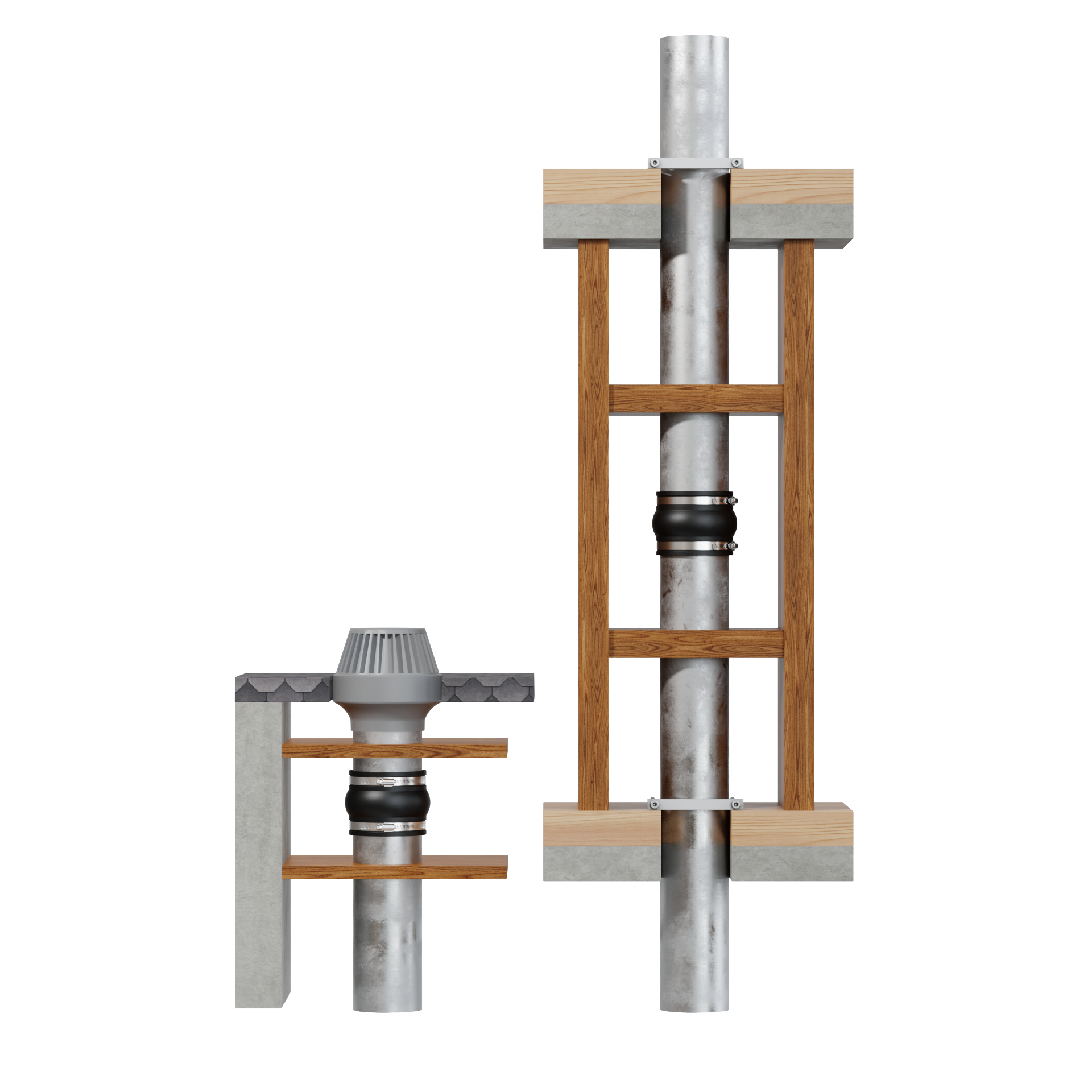
Three ways to handle the same movement.
Thermal movement in a stack gets absorbed one of three ways. Which one belongs on the job depends on the space in the chase, what the specification calls for, and how much labor the offset would cost.
One-piece elastomeric joint
- Molded body, two stainless clamps, nothing telescopes
- Installs in the line at a 4″ normal position
- 1½″ expansion, ½″ contraction
- Fits plastic, cast iron and steel, 1½″ to 6″
- 140°F intermittent, gravity DWV only
Telescoping cast iron joint
- Cast iron body with a sleeve sliding in a packing gland
- More travel per joint
- Heavier, and a bolted assembly to set at installation
- Packing and sliding surfaces can bind or weep over time
- Offered in larger sizes than the elastomeric range, up to 10″
Expansion offset
- Movement absorbed by bending a jogged run of pipe
- No product to buy beyond fittings
- Consumes horizontal space the chase may not have
- More fittings and more joints, so more labor
- Has to be drawn, coordinated and built in the field
What it is made of, and what it will take.
Flexible PVC body with 300 series stainless steel clamp bands. XJ-6 uses a 316 series high torque band.
| Gasket | Flexible PVC, Shore A 65 ±5 |
| Clamp bands | 300 series stainless steel. XJ-6: 316 series high torque band. |
| Installation torque | 60 in-lb. XJ-6: 120 in-lb. |
| Tensile strength | 1000 psi minimum |
| Elongation at rupture | 250% minimum |
| Tear strength | 150 lb/in. minimum |
| Brittleness temperature | −40°F |
| Application | Above-ground vertical DWV and rainwater conductors |
| Movement | 1½″ expansion, ½″ contraction from a 4.00″ normal position |
| Maximum test pressure | 4.3 psi |
| Maximum operating temperature | 140°F intermittent. No continuous rating published. |
| Fits | Plastic, cast iron and steel pipe |
- Above ground only. Not a buried fitting.
- Vertical service. Designed for stacks and conductors, not horizontal runs.
- Not a support. The piping has to be carried and guided independently.
Loosen, insert, set, torque.
The whole install happens in the line with standard tools. Full instructions ship with the product and are in the documents below.
- Loosen both clamps
- Insert pipe to the stops
- Set the normal position
- Torque to 60 in-lb (120 in-lb on XJ-6)
- Support and test
What to put in the submittal.
Everything a plan reviewer or a code official is going to ask for, in one place.
| ICC-ES PMG-1117 | To ASTM C1173 and CSA B602. Covers XJ-150 through XJ-4. Above-ground use is subject to the approval of the code official. |
| ASTM C1173 | Flexible transition couplings for underground piping systems |
| CSA B602 | Mechanical couplings for drain, waste and vent pipe and sewer pipe |
| ASTM D5926 | Gasket, per Fernco published data |
| Specify under | CSI 22 05 16 |
- Travel in both directions. 1½″ expansion and ½″ contraction from a 4.00″ normal position.
- Movement calculations. Section lengths and temperature range for the pipe actually specified.
- Supports and guides. The joint takes movement; it does not carry or align the stack.
- Size coverage. XJ-6 sits outside the PMG listing, so confirm it before specifying.
Documents.
Sell sheet with the full part table, technical data and the stack installation illustration.
 Expansion Joint Sell SheetSell sheet · Parts, travel and technical dataDownload PDF Expansion Joint Flyer (Canada)Flyer · Canadian marketDownload PDF Fernco Plumbing CatalogCatalogDownload PDF
Dimensional drawings.
One drawing per part, for submittals and spec packages.


Common questions.
How much movement does one joint take?
1½″ of expansion and ½″ of contraction, measured from the 4.00″ normal position it installs at. Contraction is the tighter of the two, so size the section for the cold case as well as the hot one.
Which size do I need?
Go by the measured outside diameter of the pipe, not the nominal size. XJ-150 fits 1.65 to 2.00″, XJ-2 fits 2.15 to 2.50″, XJ-3 fits 3.15 to 3.70″, XJ-4 fits 4.10 to 4.65″ and XJ-6 fits 6.30 to 6.80″. The ranges cover Schedule 40 plastic and steel at every size, and cast iron no-hub and service weight at 2″ and larger.
How many joints does a stack need?
That comes out of the design rather than a rule of thumb. Work out the expansion and contraction for each section between anchors using the pipe manufacturer’s published coefficients, compare it with the travel available at the joint, and shorten the section or add joints if it does not fit. The calculator above does the arithmetic for a single section.
Can I use one on a horizontal run or underground?
No. These are for vertical, above-ground DWV stacks and inside rainwater conductors. They are not a buried fitting and not a pressure fitting; maximum test pressure is 4.3 psi.
Does the joint support the pipe?
No. Supports and guides carry the piping and keep it in alignment. The joint only absorbs movement, and a stack that leans on it will not behave the way the design assumed.
Are they code listed?
XJ-150 through XJ-4 are covered by ICC-ES PMG-1117 to ASTM C1173 and CSA B602, and above-ground use is subject to the approval of the code official. The gasket conforms to ASTM D5926 per Fernco published data. The new XJ-6 is not on that listing yet, so confirm acceptance before specifying it where a listing is required.
What temperature can they take?
140°F intermittent. Fernco publishes this as non-consistent, and there is no continuous rating. Brittleness temperature is −40°F at the cold end.
Does it matter what the weather is on install day?
Yes. On a very hot or very cold day the pipe may already be part-way expanded or contracted as it acclimates, which changes how much travel is left in each direction. Set the joint at its normal position and account for the installation temperature when you calculate movement.